Creating a Food Forest

A food forest will be a key feature of Dandelion Commons.
Food forests, also known as perennial polyculture gardens, are a method of growing a variety of edible plants together. To begin, let's define a few important terms:
- Perennial - a plant that lives over two years
- Polyculture - several species of plants that share space and form interrelationships
- Plant guild - a group of plants and animals that benefit one another
Food forests are made up of one or more plant guilds with a variety of plants in each ecological forest layer:
- Canopy trees - the tallest, most dominant trees
- Understory - trees, shrubs, and plants that grow in the shade of canopy trees
- Ground layer - plants that grow close to the ground
- Vines - plants growing on top of other plants
- Root zone - roots growing under the ground
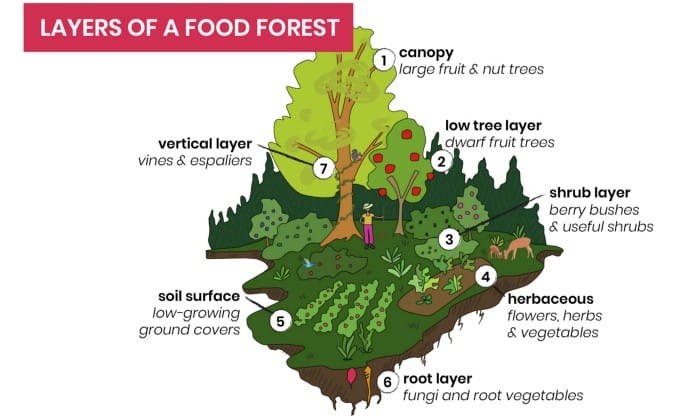 Illustration from Nigel Kay
In a food forest, some of these plants will produce edible fruits and vegetables, while others are included because they are beneficial to other plants and form a healthy ecosystem.
Food forest guilds are carefully designed with knowledge of which plants get along with and benefit each other. A classic example of a guild is the Black Walnut tree guild. Black Walnuts are a great source of food for people and animals, but they produce a a chemical called juglone. Juglone is alleopathic to many other plants and will hinder their growth. But, many plants get along well with Black Walnut trees, including crab apple, paw paw, persimmon, red bud, raspberries, and morel mushrooms. A few annual vegetables also tolerate Black Walnut trees: onions, melons, corn, beans, squash, beets, and potatoes. Black Walnut guilds grow best along shorelines that are occasionaly flooded.
For more information about how to create a food forest, check out our sourcebook: The Food Forest Handbook: Design and Manage a Home-Scale Perennial Polyculture Garden, by Darrell Frey & Michelle Czolba.
Our ideal piece of land will have a combination of pasture and forest with a natural creek. Immediately after purchasing, we will survey and label all of the trees and shrubs growing on the land, removing harmful invasive species and identifying trees that are ideal candidates for food forest guilds. We will plant companion species in the existing forest and cultivate new food forest guilds with Arkansas native plants in micro forests around community and tiny homes for easy access.